Pages

Showing posts with label Lockheed. Show all posts

Monday, 22 April 2013

Lockheed AH-56 (Cheyenne)

An attack helicopter developed for the United States Army by Lockheed which is known as Lockheed AH-56 Cheyenne rose from the Army's Advanced Aerial Fire Support System (AAFSS) program in order to field the service's first dedicated attack helicopter.

4992

Cheyenne was designed by Lockheed to use a four-blade rigid-rotor system. Lockheed configured the aircraft as a compound helicopter. This aircraft also featured a tail-mounted thrusting propeller, low-mounted wings, and a single General Electric T64 turboshaft engine. In order to provide armed escort for the Army's transport helicopters, such as the Bell UH-1 Iroquois, the Cheyenne was to have a high-speed dash capability.

SPECIFICATIONS:
Armament: Guns: 1) One nose turret with either an M129 40 mm (1.57 in) grenade launcher or an XM196 7.62x51 mm machine gun 2) One belly turret with an XM140 30 mm (1.18 in) cannon | Hard-points: Six | Missiles : BGM-71 TOW missiles | Rockets : 2.75 in (70 mm) FFA rockets
Engine: One General Electric T64-GE-16 turboshaft, 3,925 shp (2,930 kW)
Rotor systems: 4 blades on main rotor, 4 blades on tail rotor, 3 blades on pusher propeller
100_0165Maximum speed: 244 mph
Range: 1,225 miles
Service ceiling: 20,000 ft.
Length: 54 ft. 8 in.
Height: 13 ft. 8.5 in.
Weight: 18,300 lbs. loaded
Cruise speed: 255 mph
Rotor diameter: 51 ft. 3 in.
Fuel capacity: Internal: 7,320 L of JP-5 fuel | External: Two 1,136 L tanks
Crew: Two (one pilot, one copilot/gunner [front seat])

The Army awarded Lockheed a contract for ten AH-56 prototypes in 1966 and a production contract, based on flight testing progress later in January 1968. The AH-56's first flight took place on 21 September 1967. On 19 May 1969, the production contract of Cheyenne was being canceled due to a fatal crash and technical problems affecting performance. Due to the problems too, Cheyenne development had been put behind schedule. However, the development of the Cheyenne continued with the hope that the helicopter would eventually enter service.

ah-56-plan

The Army canceled the Cheyenne program on 9 August 1972 due to the controversy with the United States Air Force over the Cheyenne's role in combat as well as the political climate regarding military acquisition programs. These were the reasons that had caused the Army to correct the service's attack helicopter requirements in favor of a twin-engined conventional helicopter which was viewed as less technical and more survivable. On 17 August 1972, the Army announced a new program for an Advanced Attack Helicopter (AAH) which led to the development of the AH-64 Apache.

Sunday, 21 April 2013

Lockheed C-5 (Galaxy)

"Galaxy" or also known as the Lockheed C-5 which was built by Lockheed is a large military transport aircraft. Lockheed C-5 provides a heavy intercontinental-range strategic airlift capability, one that can carry outsize and oversize cargos, including all air-certifiable cargo for the United States Air Force (USAF). There are many similarities between the C-5 Galaxy and its smaller predecessor, the C-141 Starlifter, and the later C-17 Globemaster.

7114457683_498ebe9e31

The C-5 Galaxy is one of the largest military aircraft in the world. It had a complex development because significant cost overruns were experienced and Lockheed suffered from the significant financial difficultiesFractures in the wings of many C-5 aircraft were discovered shortly after it entered for service. Due to this problem, the C-5 fleet were limited in capability until corrective work was carried out. An upgraded version of C-5 is known as the C-5M Super Galaxy. It is built with new engines and modernized avionics. C-5M was designed to extend its service life beyond 2040.

SPECIFICATIONS:
  • Engine :  Four General Electric TF39-GE-1C
  • Range : 2,760 miles (4,440 km) with a 263,200 lb (119,400 kg) payload
  • Service ceiling : 35,700 ft. at 615,000 lbs. gross weight
  • Span : 222 ft. 9 in.
  • Length :  247 ft. 1 in.
  • Height : 65 ft. 1 in.
  • Weight : 769,000 lbs. loaded
  • Crew : Typical: Seven (aircraft commander, pilot, two flight engineers, three loadmasters) | Minimum: Four (pilot, copilot, two flight engineers)
  • Thrust/weight : 0.22

lockheed_c5b_josephkwagner

The C-5 Galaxy has been operated since 1969 by USAF. During that time, the Lockheed C-5 Galaxy has been used to support US military operations in all major contingencies which include Vietnam, Iraq, Yugoslavia and Afghanistan; as well as in support of allies, such as Israel during the Yom Kippur War and NATO operations in the Gulf War. Not to mentioned that it has also been used to distribute humanitarian aid and disaster relief, and support the US Space Shuttle program run by NASA.

Lockheed F-104 (Starfighter)

The high-performance single-engine supersonic interceptor aircraft, Lockheed F-104 or also known as "Starfighter" was basically developed by Lockheed for the United States Air Force (USAF). Starfighter is one of the Century Series aircrafts.

Harry Curzon's F104 Starfighter

This aircraft served with Air National Guard units until it was phased out in 1975 after serving the USAF from 1958 until 1969. A small mixed fleet of F-104 types were flew by the National Aeronautics and Space Administration (NASA) in supersonic flight tests and spaceflight programs until their retirement from the programs in 1994.

SPECIFICATIONS:
Armament: Guns: One 20 mm (0.787 in) T171 Vulcan 6-barreled Gatling cannon, 725 rounds Hard-points:  Seven with a capacity of 4,000 lb (1,814 kg) | Missiles : Four AIM-9 Sidewinder | Others : Bombs, rockets, or other stores
f104_1_3vEngine: One General Electric J79-GE-11A afterburning turbojet | Dry thrust: 10,000 lbf (48 kN) | Thrust with afterburner: 15,600 lbf (69 kN) Maximum speed: 1,328 mph
Range: 1,630 miles
Service ceiling: 50,000 ft.
Span: 21 ft. 9 in.
Length: 54 ft. 8 in.
Height: 13 ft. 6 in.
Weight: 20,640 lbs. loaded Crew: One

The F-104S all-weather interceptor equipped with radar-guided AIM-7 Sparrow missiles which was designed for the Italian Air Force by Aeritalia, was the ultimate production version of the basic fighter model F-104.  The CL-1200 Lancer, an advanced F-104 with a high-mounted wing, however, did not proceed past the mock-up stage.

3View-Color-Lockheed-F-104

A NATO competition for a new fighter-bomber, was won by the F-104G model which was the product after a set of modifications had been done to the original F-104 model. The F-104 Starfighter served with the air forces of over a dozen nations. With its retirement  in May 2004 by the Italian Air Force, the operational service of the Starfighter ended after its introduction in 1958 by the USAF.

Monday, 8 April 2013

Lockheed P-80 (Shooting Star)


P-80 SHOOTING STAR

Lockheed P-80 or also known as the "Shooting Star" , was built and designed by Lockheed in 1943. This aircraft which was the first jet fighter used operationally by the United States Army Air Force (USAAF) is an aircraft designed with straight wings. Shooting Star was delivered in just 143 days from the start of the design process and the production models were flying by the end of World War II though it was not ready for service.

p80
SPECIFICATIONS:
Armament: Guns: Six 0.50 in (12.7 mm) M2 Browning machine guns (300 rpg) | Rockets: Eight unguided rockets | Bombs: Two 1,000 lb (454 kg) bombs 
Engines: One Allison J33-A-35 centrifugal compressor turbojet, 5,400 lbf (24.0 kN)
Maximum speed: 600 mph 
Range: 1,200 miles 
Service ceiling: 46,000 ft. 
Span: 38 ft. 9 in. 
Length: 34 ft. 5 in. 
Height: 11 ft. 3 in. 
Weight: 16,856 lbs. loaded 
Crew: One

Complimented by the smooth lines and sleek appearance, the P-80 perhaps was the most elegant of the first generation jets. Beginning with the conical nose assembly and leads out to the simplistic-looking engine exhaust port had give a streamlined affair to the fuselage. The Shooting Star made use of an internalized system with easy maintenance access which was accomplished via a two-piece fuselage that could be separated near the engine while the other early jet-powered aircraft used to fit their engines on external nacelles under the wings.

764px-Sr71_1While the P-80 sports with only a single engine, two semi-elliptical intake openings were fitted to either side of the fuselage just ahead of the cockpit. This results in the production of the generally "wide" appearance of the aircraft when viewed from a high or underside angle. The intakes were organized in a fashion so as not to disrupt the air flow in the slightest and reached perfectly into the wing roots. Channels carved into the forward fuselage sides supported air into the intake ducts.

The laminar-flow wings that took on an elliptical shape all their own with both the leading and trailing edges narrowed into a curved wingtip to which the wingtip fuel tanks were allocated for improved range. The wings affords good forward and side vision since they were straight, low-mounted monoplane assemblies fitted just aft of the cockpit. The addition of a two-piece bubble canopy provided the pilot with unparalleled 360-degree views out of his cockpit. Only the light framing along the forward portion of the windscreen and the large-area wings to the pilot's side will obstruct the pilot's vision.

Tuesday, 19 March 2013

Lockheed SR-71 (Blackbird)


Image

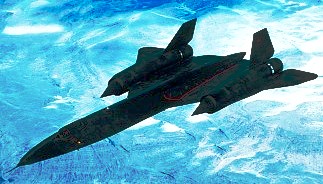
Created by Kelly Johnson, the Lockheed SR-71 also known as the "Blackbird" or "Habu", was developed as a black project from the Lockheed A-12 reconnaissance aircraft in the 1960's by Lockheed and its Skunk Works. It was aadvancedlong-rangeMach 3+ strategic reconnaissance aircraft which was designed as a high-speed high altitude aircraft, providing pre-attack and post-attack reconnaissance. During reconnaissance missions the SR-71 operated at high speeds and altitudes to allow it to out race threats. If a surface-to-air missile launch was detected, the standard evasive action was simply to accelerate and out-fly the missile.

SPECIFICATIONS: Lockheed SR-71 (Blackbird)
Armament: None
Engines: Two Pratt & Whitney J58s of 32,500 lbs. thrust each with afterburner
Maximum speed: Plus 2,000 mph
Range: Plus 2,900 miles
Service ceiling: Plus 85,000 ft.
Span: 55 ft. 7 in.
Length: 107 ft. 5 in.
Height: 18 ft. 6 in.
Weight: 170,000 lbs. loaded
Crew: Two
Serial number: SR-71A: 61-7950 to 61-7955, 61-7958 to 61-7980 | SR-71B: 61-7956 and 61-7957 | SR-71C: 61-7981

Constructed of 93% titanium alloy and composites, it produces original stealth technology. The application of a special paint giving it a higher thermal emissivity when cruising at high Mach. The paint also contains tiny iron balls that dissipates electromagnetic radiation. The paint alone adds over 60 lbs to the jet.  In order to match the strength of the aircraft's titanium structure; special fuels, hydraulic fluids, electronics, and glass had to be developed. The Blackbird was both a miracle of design and of production. The reasons behind this is due to its performance had to overcome not only the sound barrier, but also the heat barrier. The  skin temperature of the craft exceeded 1,050 °F.

The USAF tried retiring the Blackbird in 1987, since the SR-71 fleet was so expensive to maintain. The SR-71 program was completely shut down with its first official retirement in 1989. The requirement of expedited reconnaissance became clear during the 1993 conflict in Middle East which lead to the re-examination of SR-71 program by congress. The renewal of the Blackbird fleet was the result from the congress.  Due to this, the Blackbird project was finally (and permanently) retired in 1998Two last flying Blackbirds were given to NASA which flew until 1999. All but two SR-71’s (the ones given to NASA) are now in museums for people to see.